
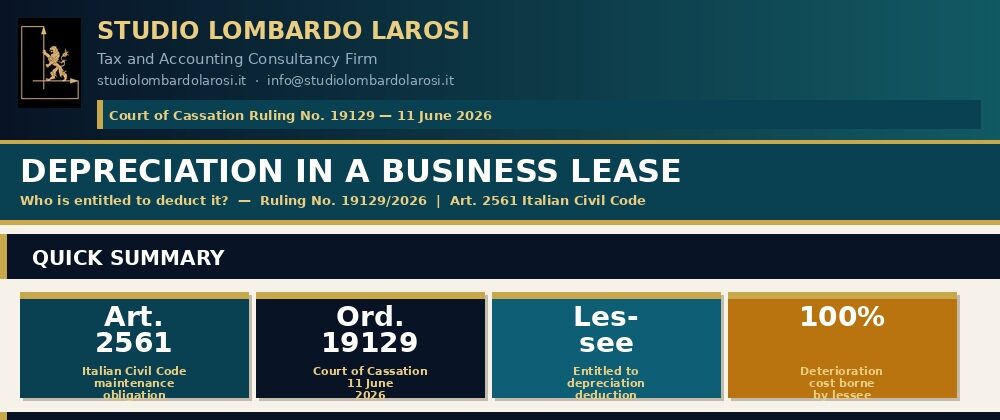
Who has the right to deduct depreciation when a business is leased out? This is far from a trivial question — it directly affects the tax position of both the lessor and the lessee. With Ruling No. 19129 of 11 June 2026, the Italian Court of Cassation has finally provided a clear answer on how depreciation in a business lease works: it belongs to the lessee, not to the owner. In this guide, Studio Lombardo Larosi explains why, what the practical consequences are, and what you need to do to handle this situation correctly.
Table of Contents
What is depreciation and why does it matter in a business lease
Depreciation is the accounting and tax process by which the cost of a fixed asset is spread across its useful life. Each year, a portion of the asset’s original value is deducted from business income, reflecting the progressive economic consumption of that asset: its physical wear and tear, deterioration from continued use, or technological obsolescence.
When it comes to depreciation in a business lease, the picture becomes more complex: the fixed assets legally belong to the lessor, but are used day-to-day by the lessee in their operations. This misalignment between ownership and use is precisely the tax issue that the Court of Cassation resolved with Ruling No. 19129/2026.
Business lease: how the tax transfer works

A business lease is a contract under which the owner of a business (the lessor) temporarily grants another party (the lessee) the right to use the entire business or a branch of it, in exchange for a periodic payment. Unlike a business sale, ownership remains with the lessor: the lessee acquires only the right of use.
From a tax perspective, however, the lessee steps into the tax position of the lessor with regard to the assets included in the leased business. This means the lessee inherits not only the assets themselves, but also their fiscally recognised values, the remaining depreciation schedules, and — as clarified by the Court of Cassation — the right and obligation to continue depreciating those assets within its own business income.
Who deducts depreciation in a business lease: the Court of Cassation’s answer
With Ruling No. 19129 of 11 June 2026, the Court of Cassation established a clear principle: the right to deduct depreciation in a business lease belongs to the lessee, not the lessor.
The Court’s criterion is that of responsibility for maintenance: the right to deduct depreciation belongs to whoever is obliged to ensure the conservation and operational efficiency of the business complex. Under a business lease, this obligation falls on the lessee. It is the lessee who uses the assets every day, subjects them to wear and deterioration, and must keep them in working order. It is therefore logical and correct that the lessee records the cost of this consumption in its own tax accounts.
The Court’s reasoning: the risk of wear follows use
The Court of Cassation’s reasoning rests on a basic economic principle: the value of a fixed asset declines as it is used. This loss in value — whether from intensive use, normal physical deterioration, or technological obsolescence — is a real cost that affects the economic activity of whoever uses the asset.
Since it is the lessee who uses the business assets, it is the lessee who bears this risk and this cost. The financial results of the lessee’s operations must therefore reflect the cost associated with the wear and deterioration of those assets. Excluding depreciation from the lessee’s income statement would distort the true picture of its activity, artificially inflating taxable income.
In short: in a business lease, the economic risk of asset deterioration transfers — together with the use of the assets — from the legal and economic sphere of the lessor to that of the lessee. Depreciation follows this transfer.
Depreciation in a business lease: what changes in practice for lessee and lessor
For the lessee
- Has the right to deduct the depreciation instalments on the assets included in the leased business
- Steps into the fiscally recognised values of the assets, continuing the depreciation schedule already begun by the lessor
- Must correctly report the depreciable assets and their related charges in the tax return
- Assumes the economic risk arising from the deterioration, use, and technological obsolescence of the assets
For the lessor
- Has no right to deduct depreciation on the assets transferred under the lease
- Continues to receive the lease payment, which constitutes the relevant taxable income
- Does not bear the risk of asset deterioration during the lease period: the cost of asset consumption falls on the lessee
- Must avoid deducting depreciation instalments in the tax return for assets included in the leased business
Summary table: depreciation in a business lease
| Aspect | Lessor | Lessee |
| Ownership of assets | ✅ Remains the owner | ❌ Not the owner |
| Use of assets | ❌ Does not use the assets | ✅ Uses the assets every day |
| Risk of deterioration | ❌ Transferred to the lessee | ✅ Borne by the lessee |
| Maintenance obligation | ❌ Transferred to the lessee | ✅ Borne by the lessee |
| Depreciation deduction | ❌ Not entitled | ✅ Entitled (Cass. No. 19129/2026) |
| Relevant taxable income | Lease payments received | Business income from operations |
Mistakes to avoid in managing depreciation in a business lease
In light of Ruling No. 19129/2026, it is important to avoid several common errors that can expose both parties to tax challenges:
- The lessor continues to deduct depreciation after signing the lease — This is the most common and most risky error. Once the business lease is in place, the lessor has no legal basis to deduct depreciation on the assets transferred under the contract.
- The lessee does not record depreciation — Conversely, a lessee who fails to record depreciation instalments produces an inaccurate picture of its business income, exposing itself to challenge in a tax audit.
- Failure to step into the fiscally recognised values — The lessee must continue the depreciation schedule at the values already recognised in the lessor’s accounts, not start from scratch or apply different rates.
- Inadequate contractual documentation — The business lease must be in written form, registered with the Revenue Agency, and must clearly list all the assets included in the business complex.
Download the infographic PDF — Depreciation in a Business Lease
Frequently asked questions (FAQ) — Depreciation in a Business Lease
📌 Can the lessor continue to deduct depreciation during the lease period?
➡️ No. According to the Court of Cassation (Ruling No. 19129/2026), the right to deduct depreciation belongs to the lessee, who assumes the risk of asset deterioration. The lessor has no basis to deduct depreciation on assets included in the leased business.
📌 Does the lessee have to restart the depreciation schedule from zero?
➡️ No. The lessee steps into the lessor’s tax position and continues the depreciation schedule already in place, applying the rates and fiscally recognised values held by the lessor at the time the lease was signed.
📌 What happens if both the lessor and the lessee have deducted depreciation in the same year?
➡️ This constitutes a duplication of deductions that exposes both parties to tax challenge. The tax returns concerned must be corrected by removing the deductions that were not legitimate. It is strongly advisable to consult a tax adviser to manage the regularisation process.
📌 Does this principle also apply to the lease of a business branch?
➡️ Yes. Ruling No. 19129/2026 expressly refers to depreciable assets included in a business that has been leased out — a principle that applies both to the lease of an entire business and to the temporary transfer of a single business branch.

Do you have a business lease and want to handle depreciation correctly?
Studio Lombardo Larosi assists you with the correct tax management of depreciation in a business lease, with the drafting of the contract and with the review of your tax return. Contact us for a personalised consultation.